
Physical Sciences
Explore Physical Sciences
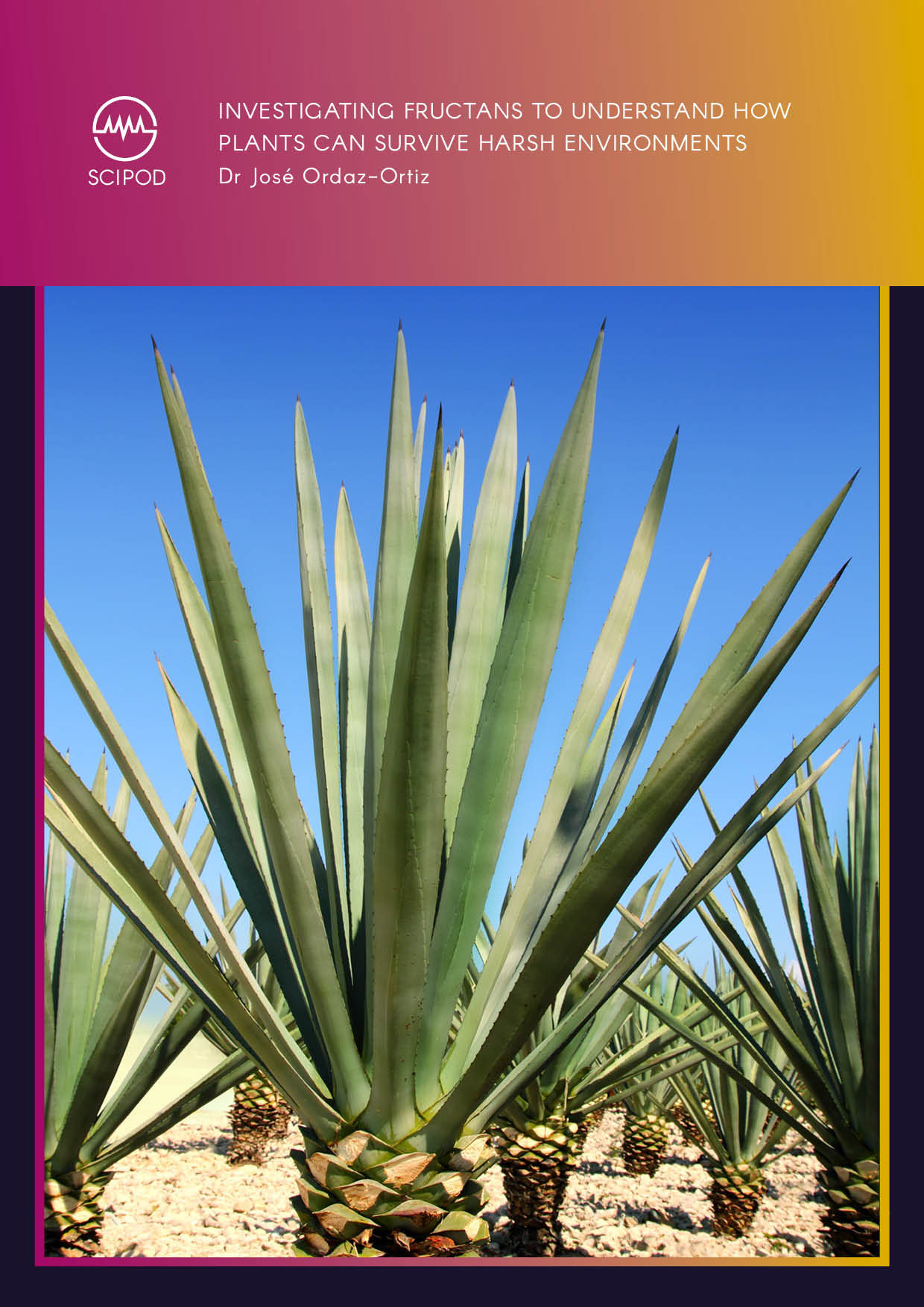
Investigating Fructans to Understand How Plants Can Survive Harsh Environments | Dr José Ordaz-Ortiz
The molecules within plant tissues can tell us about how they can withstand harsh environmental conditions. The Agave tequilana plant, native to Mexico, has a high concentration of fructan molecules throughout its tissues. Alongside his colleagues, Dr José Ordaz-Ortiz at the Center for Research and Advanced Studies of the National Polytechnic Institute in Mexico, combines several powerful analytical techniques to better understand the role that these fructans play in plant biology.

Revealing How Table Tennis Could Be Transformed into a Popular Spectator Sport | Professor Ralf Schneider
Rapid-fire rallies of short, fast shots are a defining feature of professional table tennis – but for many audiences, the excitement of these matches isn’t easily conveyed on the TV screen. Using a combination of computer simulations and statistical analysis, Professor Ralf Schneider and his colleagues at the Institute of Physics of the University of Greifswald, Germany, explore how slight changes to the game’s equipment could slow matches down, and make them more interesting to viewers. Karl Lüskow, Marc Marschall and Stefan Kemnitz produced and optimised the simulation code, while Lars Lewerentz performed statistical analysis of the data.
Exploring the Surface Chemistry of Interstellar Dust | Albert Rimola
Interstellar space may seem like the last place you would look when searching for the chemical origins of life. Yet on the surfaces of tiny dust grains within this vast expanse, complex chemical reactions are continually occurring, which likely played a key role in establishing the rich diversity of complex molecules we observe in the solar system today. In a new study, astrochemists in Spain and Italy, led by Albert Rimola at the Autonomous University of Barcelona, examine how advanced simulation techniques can be used to study these important processes on atomic scales.
Advancing Quantum Computing to Accelerate Scientific Research
About this episodeOver the past few years, the capabilities of quantum computers have reached the stage where they can be used to pursue research with widespread...

Exploring the Vast History of Chemical Space – Dr Guillermo Restrepo
SciPod · Exploring the Vast History of Chemical Space - Dr Guillermo RestrepoOriginal Article Reference This SciPod is a summary of the paper ‘Exploration of the...

Studying Blazars with Multiwavelength and Multi-messenger Astronomy – Professor Markus Böttcher
SciPod · Studying Blazars with Multiwavelength and Multi-messenger Astronomy - Professor Markus BöttcherOriginal Article Reference This SciPod is a summary of the paper...

Engineering the Path to New Semiconductors – Dr Yasuo Koide
SciPod · Engineering the Path to New Semiconductors - Dr Yasuo KoideOriginal Article Reference This SciPod is a summary of the...

Causality: A Fundamental Necessity or Part of the Problem?
SciPod · Causality: A Fundamental Necessity or Part of the Problem?Original Article Reference This SciPod is a summary of the paper ‘Is Causality a Necessary Tool for...

Understanding Reionisation In The Early Universe – Dr Nick Gnedin
SciPod · Understanding Reionisation In The Early Universe - Dr Nick GnedinOriginal Article Reference This SciPod is a summary of the...

Uncovering The Trigger For Mars’ Global Dust Storms – James H. Shirley
SciPod · Uncovering The Trigger For Mars’ Global Dust Storms - James H. ShirleyOriginal Article Reference This SciPod is a summary of the...

Superinsulators The Hideout Of Magnetic Monopoles
SciPod · Superinsulators The Hideout Of Magnetic MonopolesOriginal Article Reference This SciPod is a summary of the paper:https://doi.org/10.33548/SCIENTIA652About...

Small But Mighty Game – Changing Nanopore Research – Dr Jean – Pierre Leburton, University Of Illinois At Urbana – Champaign
SciPod · Small But Mighty Game - Changing Nanopore Research - Dr Jean - Pierre LeburtonOriginal Article Reference This SciPod is a summary of the...