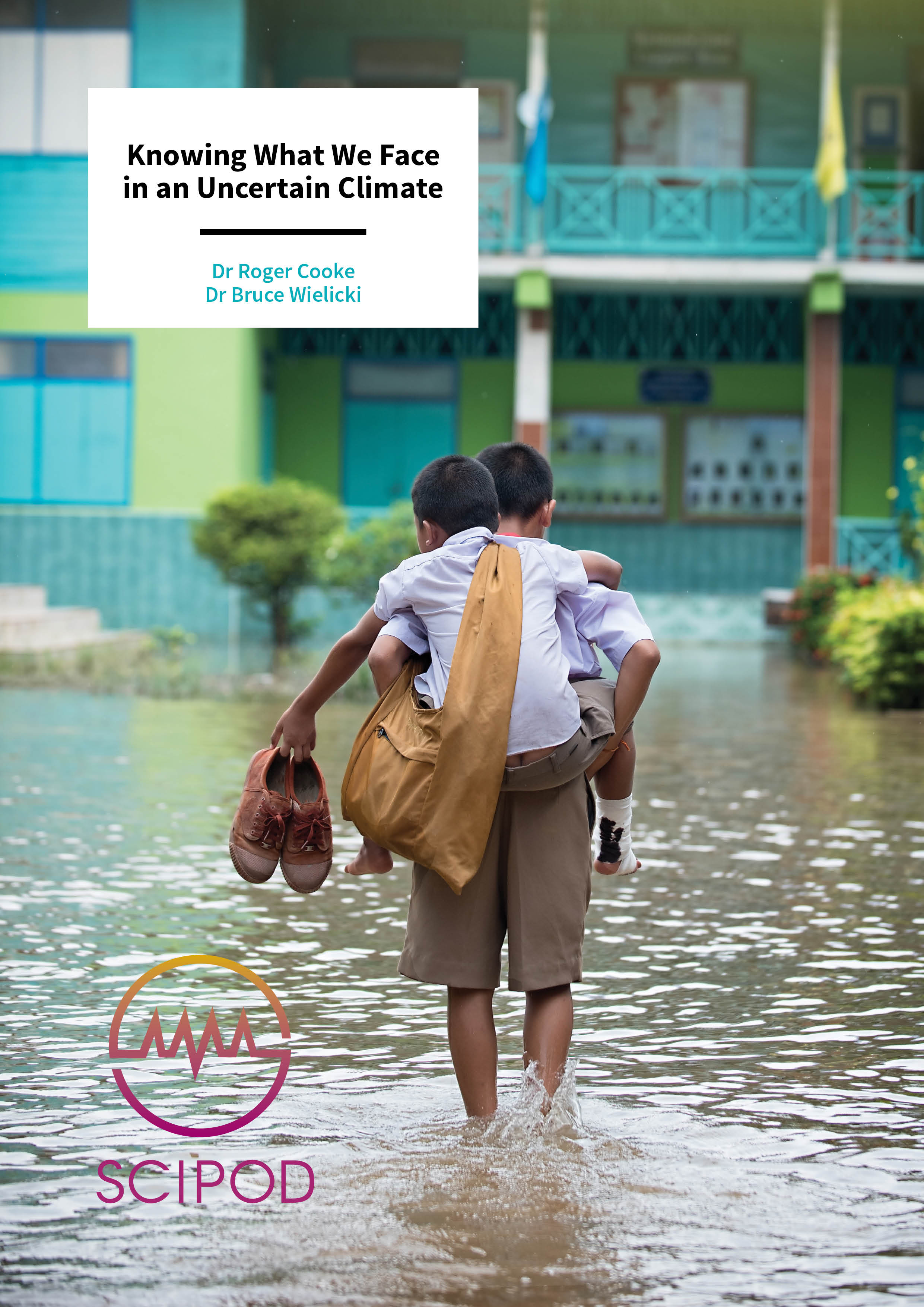
Knowing What We Face in an Uncertain Climate – Drs Roger Cooke and Bruce Wielicki

Feb 20, 2018earth and environment, social and behavioural sciences

Dr Roger Cooke of the non-profit Resources for the Future and Dr Bruce Wielicki of the NASA Langley Research Center have been researching the challenges, costs and benefits of a proposed international climate observation system capable of providing the highly valuable information needed for managing our climate.

[lbg_audio2_html5 settings_id=’52’]

You may also like …

Professor Chandra Waring | The Myth of the “Post-Racial” Family: What Multiracial Families Reveal About Race in America

In the United States, families that cross racial lines often attract admiration and curiosity. Such families are increasingly common, and they are seen by many as living proof that love conquers prejudice, and that the country is moving beyond its painful racial past. When a white mother cradles her brown-skinned baby, or a Black father teaches his lighter-skinned daughter to ride a bike, the image seems to embody progress and racial harmony. But as Professor Chandra Waring of the University of Massachusetts Lowell shows in her 2025 study, the story is far more complicated. Her article, titled “My Dad Is Racist as Hell: Navigating Racism, Monoracism, and White Privilege by Proxy in Multiracial Families,” reveals what really happens inside many multiracial households. Through interviews with 30 multiracial Americans, Waring reveals that love does not necessarily cancel racism. In fact, racism, and its quieter cousin, monoracism, often lives right inside these families.

Professor Dr Susanne Maria Maurer | How Social Work Functions as Living Memory of Society’s Deepest Conflicts

Research from Professor Dr Susanne Maria Maurer, former chair of social pedagogy at the Philipps-Universität Marburg, reveals how social work institutions and practices serve as repositories of knowledge about historical struggles over class, gender, and race. She conceptualizes social work as both a “memory of conflicts” and an “open archive” that holds different answers to social problems from across history. Her work shows that to truly understand social work today we need to look at the ideas that were pushed aside and the ongoing debates that still shape how social workers do their jobs.

Dr. Rafael Lenzi | From Magic Tricks to Spycraft: What Espionage Teaches Us About the Human Mind

When we think of spies and their activities, we imagine trench coats, hidden cameras, and tense exchanges in safehouses. Hollywood has given us the daring adventures of James Bond and Jason Bourne, along with the clever trickery of films such as Argo. But behind the cinematic flair lies a quieter, more subtle reality: espionage often depends less on gadgets, weapons and car chases than on the delicate art of deception, an art rooted in psychology, perception, and human behaviour. This is the world explored by Dr. Rafael Lenzi, in a work developed at the Centre de Recherches Sémiotiques in Limoges, France. His study of Cold War espionage, drawing on declassified CIA manuals and philosophical theories of perception, reveals how deception is not just about tricking the eye, but about shaping the mind. In other words, spying succeeds not when someone fails to see, but when they see exactly what they expect to see, and therefore overlook the trickery in front of them.

Dr. Genny Beemyn – Dr. Abbie Goldberg | Beyond the Binary: A New Generation’s Approach to Gender

In the Autumn of 2022, hopeful college students across the United States clicked through the questions on the Common Application, the digital gateway to more than one thousand colleges and universities. For the first time, alongside their grades, essays, and extracurricular lists, applicants had the chance to provide their gender and pronouns. These questions might seem a small detail, tucked between test scores and teacher recommendations, but their impact is enormous. They mark a turning point in higher education, one where students are able to represent themselves more authentically. Thanks to the work of Dr. Genny Beemyn of the University of Massachusetts Amherst and Dr. Abbie Goldberg of Clark University, we now have the first large-scale glimpse into how a new generation of young people is reshaping society’s understanding of gender.

Tanja Oschatz | Factors that Sustain the Gendered Pleasure Gap: Gendered Media Representations of Sexual Pleasure and Women’s Performance of Sexual Emotional Labor

Despite decades of awareness about gender equality, a persistent pleasure gap remains between women and men in sexual encounters, with women experiencing significantly fewer orgasms and less sexual pleasure. It is important to note that this gender difference exists primarily in contexts where women have sex with men, while women who have sex with women tend to experience more orgasms and sexual pleasure. Since the gendered pleasure gap cannot be explained by biological factors, researchers continue investigating hidden sociocultural forces that perpetuate this inequality. Two complementary studies from Tanja Oschatz at Johannes Gutenberg University and her colleagues reveal previously overlooked contributors to this gap: women’s performance of sexual emotional labor in intimate relationships and biased media representations of sexual pleasure.

Dr. Osei Appiah | How Political Identity Trumps Racial Identity in Cross-Race Conversations About Sensitive Topics

Research from communication scholars at The Ohio State University reveals fascinating new insights about the dynamics of conversations about race-related issues in the USA. Two complementary studies show that White participants expected more negative outcomes and were more likely to avoid conversations with fellow White people from different political parties than with Black people from different parties. The findings challenge assumptions about racial identity and suggest that partisan divisions have become more influential than racial divisions in shaping willingness to engage in difficult conversations.

Dr. Raymond Atwebembere | Restoring Connection: Understanding Suicide Through Human Stories

Loneliness is often described as the invisible epidemic of our time. It creeps quietly into lives, eroding confidence, weakening social bonds, and, at its most dangerous, pushing individuals toward the edge of despair. Stigma can prevent the lonely from seeking help and as loneliness is largely experienced through the prism of isolation, those in need of support may feel they have no-one to turn to. In his chapter “Loneliness, Social Isolation, and Suicidal Behavior: ‘Only Girl, Middle Child’” from the Edited Volume “Loneliness – The Ultimate Suffering in Modern Society”, Dr. Raymond Atwebembere of the Washington University in St. Louis examines this crisis not through abstract statistics alone but through vivid personal stories. His work underscores the truth that loneliness is not just a feeling; if left unaddressed it can be lethal.

Professor Ukamaka Oruche | When Science Meets Real-world Barriers: Lessons from the Frontlines of Mental Health

By all measures, America’s mental health system is stretched too thin. Families are in crisis, community mental health providers are overworked, and groundbreaking research often struggles to find its way into real-world practice. But thanks to researchers such as Professor Ukamaka Oruche of the University of South Florida, and colleagues, we’re learning how to map and close that gap, one challenge at a time. When we think of medical breakthroughs or scientific discoveries, we often imagine white coats, high-tech labs, and swift translation from theory to practice. But in the world of mental health, particularly in community settings that serve the most vulnerable, reality looks very different. Shockingly, it can take 17 to 20 years for evidence-based mental health interventions to become part of everyday clinical care.

Dr. Adam W. Carrico | Biobehavioral Approaches to HIV Prevention and Treatment in Sexual Minority Men Who Use Stimulants

Research from Dr. Adam W. Carrico at the Florida International University, and his colleagues, explores innovative approaches to address HIV prevention and treatment challenges among sexual minority men who use stimulants. Three interconnected studies examine how behavioral interventions can reduce HIV viral load, alter gene expression in immune cells, and increase the use of preventive medication in this high-priority population. Collectively, these randomized controlled trials provide compelling evidence of the potential of behavioral interventions to improve health behaviors and outcomes.